

About the U shaped membrane and the grass shaped membrane
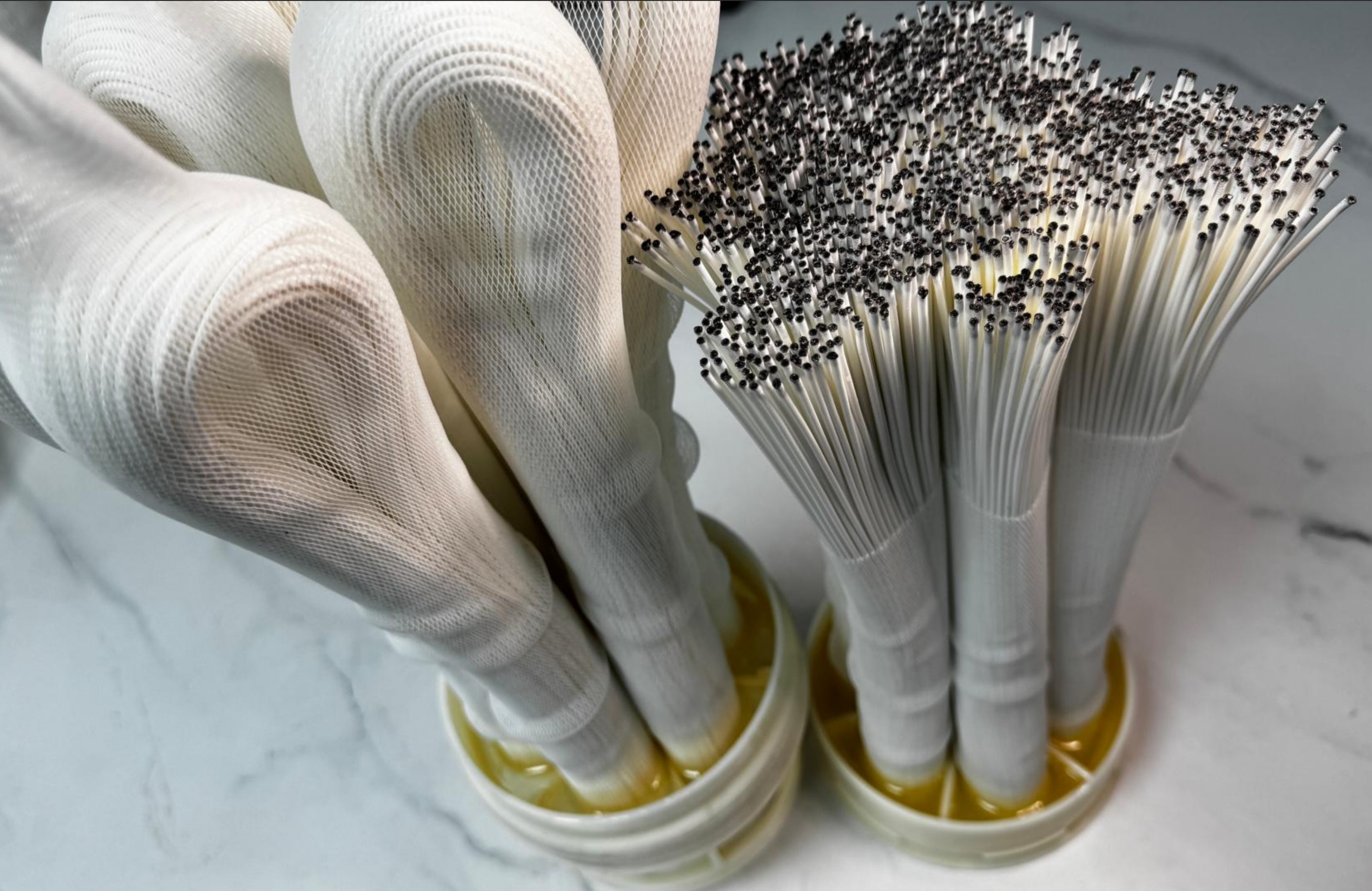
Under the same PVDF material and with a support layer, for the specific maintenance method of "hand washing," the "seaweed-shaped membrane" (commonly referred to as "curtain" or "flat-sheet" membrane) generally performs far better than the "U-shaped membrane." The seaweed-shaped membrane consists of individual membrane fibers arranged in parallel, with wide, open gaps naturally existing between each fiber, allowing for greater surface accessibility. Contaminants primarily form a filter cake on the open surface, and during manual scrubbing or water flushing, the entire layer of contaminants can be easily peeled off. The filter element can be unfolded like a fan, and the surface can be directly flushed with tap water or cleaning solution, allowing the water flow to directly act on the contaminated surface. During hand washing, each part of each membrane can be kneaded and scrubbed. The parallel arrangement, usually with the upper ends fixed, prevents entanglement and makes organization and inspection easier. The structure itself is relatively less dependent on automation (such as aeration), making it more suitable for physical cleaning.
The U-shaped membrane consists of single membrane fibers bent into a U-shape, forming narrow, relatively closed gaps between the U-shaped membranes in the same group. Surface accessibility is poor, with mainly the outer curved surface exposed. The inner curved surface and the areas where adjacent membrane fibers are in close contact form cleaning dead zones, where contaminants easily get stuck in the narrow gaps and bends, forming dense blockages. During flushing, the water flow mainly flows over the outer surface, making it difficult to effectively penetrate the internal gaps, resulting in low cleaning efficiency. The bottom of the U-shaped membrane is a free end, and without an outer mesh wrapping, multiple sets of U-shaped membranes can easily become entangled when placed side by side, making manual separation and inspection more difficult. However, the U-shaped membrane is more suitable for automated cleaning; its design is intended to rely on stable aeration flushing to maintain the cleanliness of the gaps and membrane surface.